The State of Company Formation in Sri Lanka
First edition · July 2026
Sector mix, ownership and foreign participation in new private limited companies, covering 2020 to 2025 with 2026 to date.
Download the report (PDF, 20 pages)
We incorporate private limited companies for a living. That means we have been sitting on six years of structured data about who starts companies in Sri Lanka, what they say they are going to do, who owns them and where they register. The Registrar publishes totals, and stopped publishing those after 2022. Nobody publishes the texture underneath.
This report is our attempt at that texture: formation volume, sector mix, ownership structure, foreign participation and geography, covering 2020 through 2025 with 2026 to date.
Formation is running about five times its 2020 level
Registrations grew in every complete year of the period except one. 2025 ran at 4.9 times the 2020 level and was up 36.7 percent on 2024 alone. 2022 is the flat year, which will surprise nobody who was trying to open a letter of credit that year.
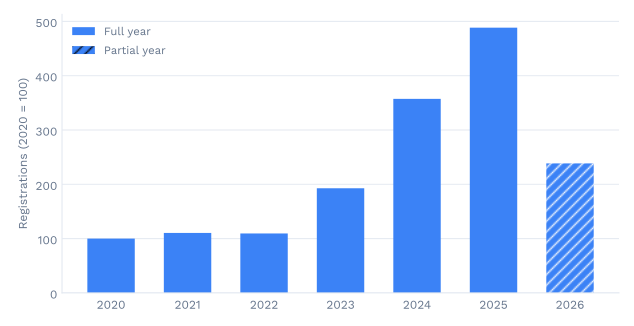
That dip is a useful check on the data. The Registrar's own series shows new registrations falling from 18,434 in 2021 to 17,819 in 2022, and the World Bank's Sri Lanka series shows the same direction. Our index moves the same way in the same year, on a completely separate book.
Quarterly figures show the same climb with no real seasonal pattern. Company formation is not tied to a filing deadline the way tax work is, so volume tracks demand rather than the calendar. If you are planning capacity around this, there is no quiet season to schedule your slow work into.
We publish this as an index rather than a count. The shape of the curve is the useful part, and it is the part that carries over to anyone else's book.
Half of all new companies have exactly one owner
This is the finding that changed how we think about our own clients. 83.1 percent of new private limited companies have no more than two shareholders. 51.9 percent have a single owner holding every share. Companies with five shareholders or more come in at 1.8 percent.
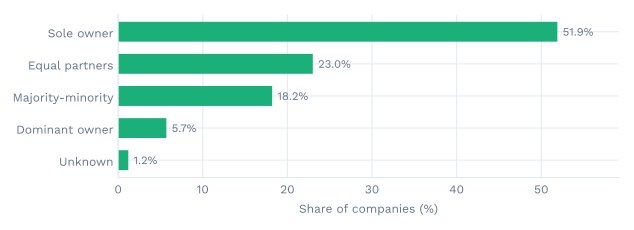
Where there is more than one owner, the even split dominates. 23.0 percent of companies divide their shares equally between partners, against only 5.7 percent where one shareholder holds a controlling block of 75 percent or more.
That fifty-fifty arrangement deserves a second look. It is the natural thing to do when two friends start something together, and it means neither party can sell, issue shares or remove a director without the other agreeing. Most people setting it up have not thought through the deadlock case. If you are one of them, a shareholders' agreement costs a lot less than the alternative.
Director counts follow the same shape as shareholder counts, which tells you these owners are running the businesses themselves rather than appointing outside management.
Trading leads the sector mix, but read it carefully
Sri Lankan incorporation documents carry no industry code. What they carry is a statement of objects written by the applicant, running anywhere from two words to several paragraphs. We matched every statement against a keyword list mapped to ISIC Rev.4 sections, so the figures can sit beside national statistics.
Wholesale, retail and trading is the largest category at 49.5 percent of classified registrations. Manufacturing follows at 26.2 percent, professional and business services at 19.9 percent, tourism and hospitality at 19.1 percent. Information technology and software takes 14.5 percent.
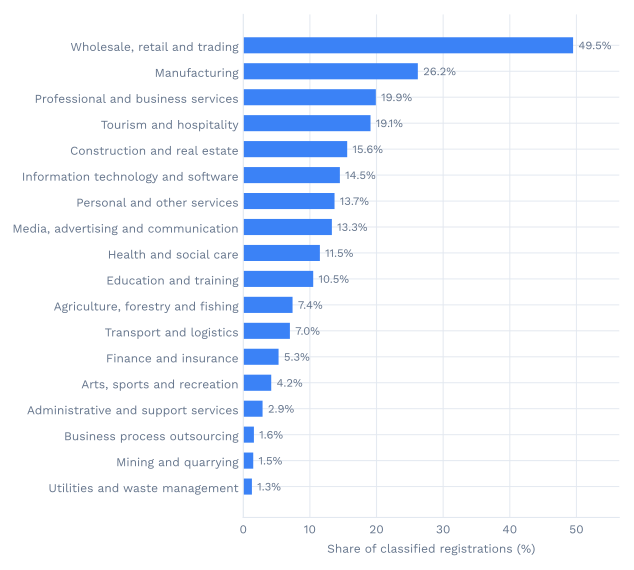
The trading number overstates trading. Applicants add import, export and general trading clauses to filings as a precaution, whether or not that is the business. The categories below it carry more signal, because a company only claims manufacturing or hospitality when it means it. Shares add up to more than 100 percent because a company stating several activities gets counted under each.
Between 2024 and 2025 the mix moved a little. Tourism and hospitality gained 1.7 percentage points of registrations, while media, advertising and communication lost 1.6. Sector shares move slowly when the underlying population is growing this fast, because a category has to add a lot of new companies just to hold its share.
Foreign participation recovered from the crisis
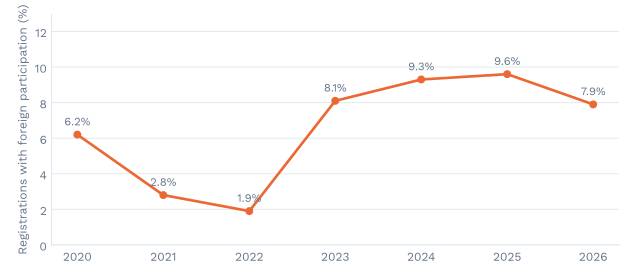
9.6 percent of 2025 registrations had at least one foreign director or shareholder, against 8.1 percent across the whole period. The path there is the interesting part: it fell to 1.9 percent in 2022, during the currency crisis and import controls, and has climbed back since.
Foreign shareholders declare 33 countries of origin, but the distribution is top heavy. India (29.1 percent), Maldives (12.7 percent) and the United Kingdom (7.3 percent) together account for just under half of all foreign shareholders.
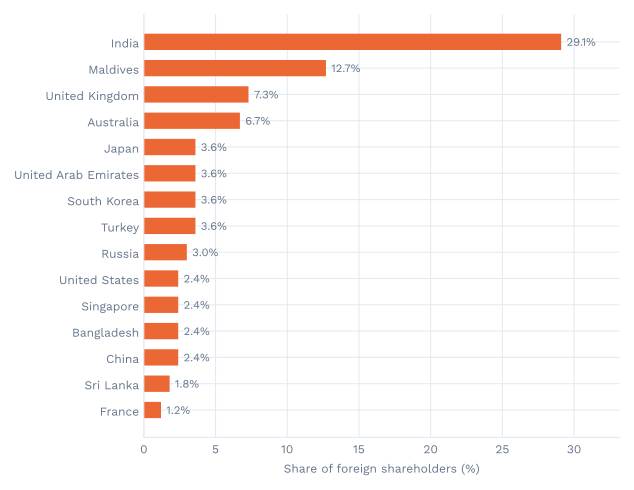
This is the part of the report we could find no Sri Lankan comparison for at all. The Board of Investment names its top source countries by value of investment, which is a different question and a different population. The only other public attempt we know of came from the Sunday Times in August 2025, which asked the Registrar for foreign and joint-venture registration figures, got no response, and published an estimate extrapolated from BOI approvals instead. Our figures are observed shareholder nationality in incorporation filings, so they will not line up with either.
How much they own splits into two camps rather than settling in the middle. 41.2 percent of companies with a foreign shareholder are wholly foreign owned. Another 41.2 percent hold under half. Middling stakes are rare. That fits two different intentions: a foreign founder setting up their own subsidiary, or an outside investor taking a position in a business that stays locally controlled.
Foreign-backed companies also pick different sectors. They over-index in professional and business services (13.3 percent of foreign-backed registrations against 8.4 percent of local-only ones), in tourism and hospitality (12.5 against 8.1) and in IT (8.3 against 6.2). They under-index in manufacturing, 7.1 against 12.1.
Three districts hold three quarters of registered offices
Colombo alone accounts for 50.5 percent of companies with a recorded district. Add Gampaha at 18.5 percent and Kalutara at 6.1 percent and the top three reach 75.1 percent across 24 districts in all.
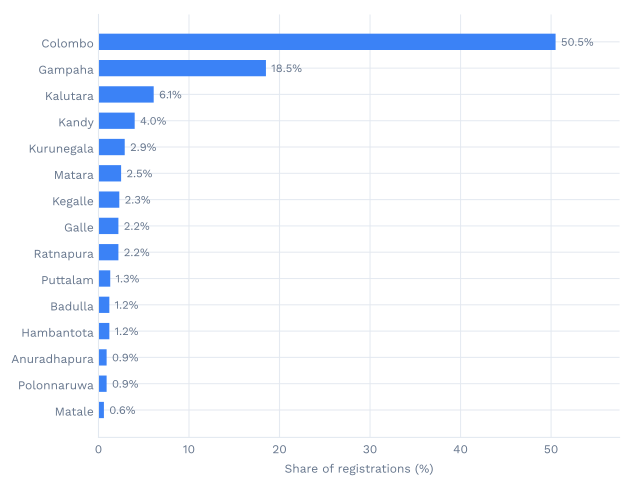
A registered office is an administrative address, not necessarily a place of business, so this measures where companies choose to be reachable rather than where they trade. Even allowing for that, three districts out of 24 taking three quarters of the register is a lot.
Method, and what this is not
This is not a census of the Sri Lankan register. These are private limited companies formed through one incorporation practice, and any practice attracts particular kinds of client. Public companies, companies limited by guarantee, overseas companies and offshore companies are all excluded. Read it as a detailed picture of one segment rather than a national statistic.
Business activity is classified from the applicant's statement of objects, matched against a keyword list mapped to ISIC Rev.4. Classification is multi-label, so shares sum above 100 percent, and 24.6 percent of records carry no usable statement of objects and sit outside the sector base.
A company is counted in the year it was incorporated. 2026 is incomplete, drawn as such, and left out of every growth comparison.
One warning for anyone benchmarking these figures against official numbers. The published Sri Lankan sources do not agree with each other, and they do not all measure the same thing. The Registrar's performance report gives new registrations to 2022. The Ministry of Industries' 2024 report on the Registrar states 32,252 registered companies for 2023, but that figure is approved company names rather than incorporations, and the same document elsewhere says about 20,000 companies are incorporated annually. Name approvals are not incorporations. We publish an index against a base year precisely so that our numbers cannot be quietly mixed into that pile.
The report publishes no company counts. Every figure in it is a share, a rate or an index value. That is a deliberate constraint, enforced in the code that builds the document, so we can describe the market's shape without disclosing our own book. The full method and four stated limits of the data are set out in the PDF.
Every chart, the complete sector and country tables, and the stated limits of the data.
Download the report (PDF, 20 pages)
We plan to run this annually. If there is a cut of the data you want and cannot find anywhere else, tell us and we will look at including it in the next edition.
Related Articles
Bizadvisor Launches Advisor AI: 24/7 Trilingual Business Advice Directly on WhatsApp
Advisor AI is the Bizadvisor assistant on WhatsApp. Message +94 77 609 1167 to check whether a company name is free at the ROC, get package prices, and ask about tax, annual returns and BO forms in English, Sinhala or Tamil.
Quarterly Income Tax Instalments in Sri Lanka: IRD's Revised Method for 2026/2027
IRD Circular SEC/2026/E/06 sets how quarterly income tax instalments are calculated from the Year of Assessment 2026/2027. First instalment due on or before 15 August 2026. The formula, the three methods, and what to file.
Tradebook: Offline Invoicing App for Sri Lankan SMEs
Tradebook is a desktop invoicing app built for Sri Lankan small businesses. It works 100% offline, keeps your data on your own computer, and creates valid VAT tax invoices the way the IRD expects.